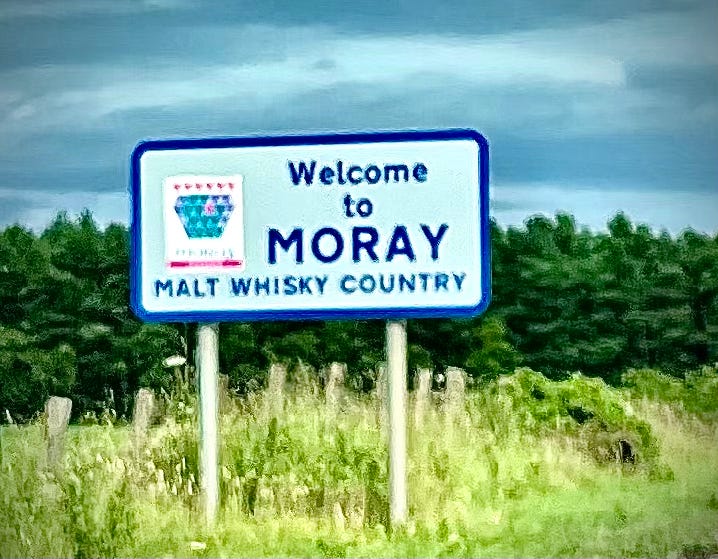
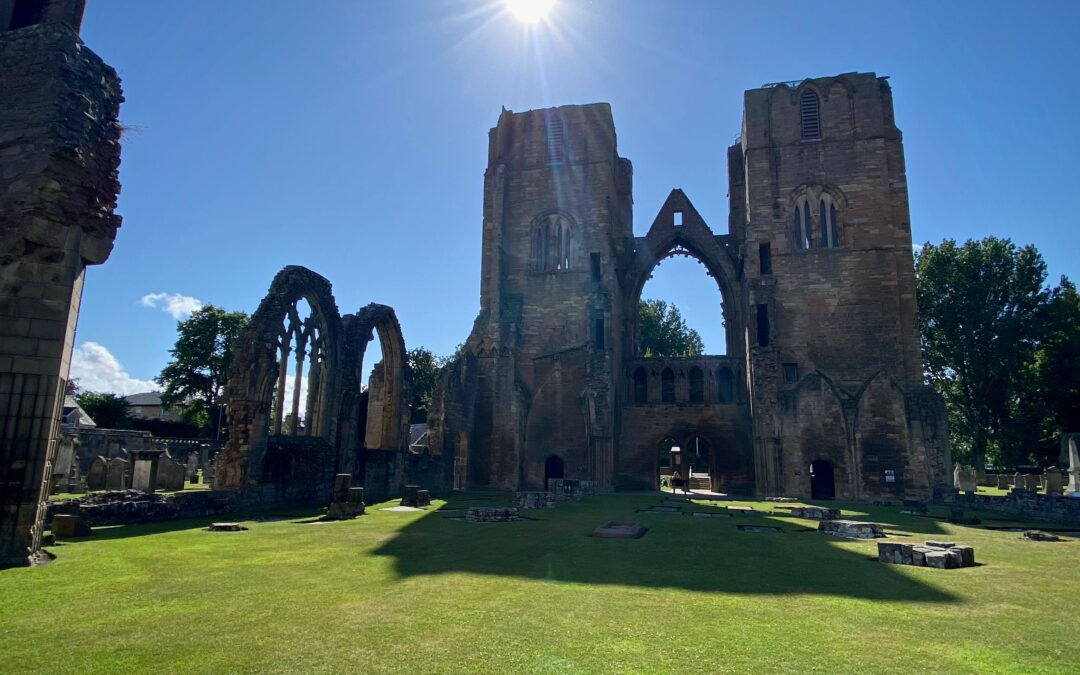
Over many years I have been tracing my family line, the Murray line, from our Scottish lineage, beginning with a Flemish warrior named Freskin. He won rights to the region of Moray (pronounced, with the Scottish lilt, “moo-rday”= murray) after serving King David I in the latter’s efforts to squelch what was destined to be the last rebellion of the Moraymen (Picts) in AD 1130.
I write about it now because I have been thinking about my ancestor Bishop Andrew Murray — progeny of Freskin and beneficiary of the melee he mounted, and the protogonist of this tale. The impact the good bishop had on his culture during the short time he had on this earth is something I want to ponder, as a Christian. It is something worthy to be pondered by any person of faith who senses a desire to have an impact on whatever realm he or she inhabits for this short time on earth.
Getting back to the story: During a trip to Scotland a few years ago, my brother, with his signature wit, referred to Bishop Andrew Murray as “crazy Uncle Andy”—as a way to distinguish him from the line of several other “Andrew Murrays” through whom my family lineage is directly drawn (and about whom more will be written in due course).
The Pictish royal line of the Moraymen, under the leadership of the MacAlpin peoples (the last of the Pictish royal lines) were stubbornly resisting what was becoming the consolidation of a Christian Scotland under King David’s I rule (r. 1124 to 1153). His ascent to the throne and his reign were met with visceral contempt by these noble tribemen. In 1130, the followers of the house of Alpin mounted an insurgency against King David that became known as “the insurrection of the Moraymen.” The Scottish King marched north into the Province of Moray to quash the rebellion and, to that end, solicited the prowess of a Flemish warrior who had come to Scotland—along with many Flemish people—in the early 12th century. (The Flemish were known “a brave and sturdy people . . . skilled at working in wool, experienced in trade, ready to face any effort or danger at land or sea in pursuit of gain; according to the demands of time and place quick to turn to the plough or to arms; a brave and fortunate people.”) The king commissioned this young warrior, named Freskin—my progenitor—to lend his skills in taming the turbulent Moraymen in order to, at long last, subdue the region of Moray.
Freskin succeeded and was awarded extensive lands in Moray as his reward. He was also tasked with defending the region. He built defensive works at a location in Moray called Duffus, near Elgin, and married into the Duffus branch of the Royal House of Moray, which fortified and expanded his territorial gains.
Once Freskin had stabilized the region, having been ensconced (along with his heirs) as lord of Duffus, King David was free to attend to his religious strategic missional engagements. He was a devoted Christian, after all, who was later canonized a saint. David’s intention had not simply been to consolidate a unified Scotland politically; he set his heart upon cultivating a Christian Scotland, though, inevitably, the two realms would serve similar ends. David’s desire to recreate a unified Scotland under the banner of Christ would result in a network of bishoprics scattered throughout Scotland, totaling 13, not the least of these was the bishopric of Moray and the well-known team of the “Bishops of Moray.”
I have been especially moved by the life and mission of Freskin’s great-grandson, Andrew, son of Hugh, who was the brother of another of Freskin’s grandsons and my direct ancestor, William. So my research has taken a slight detour down the “cousin” line of my ancient kin, focusing for a time on Andrew, the son of Hugh, and especially his role as a bishop. He became the renowned Bishop Andrew Murray, a.k.a “Crazy Uncle Andy.”
“Crazy Uncle Andy” captured my imagination, not only because of the role he played in creating the cultural and religious ethos in the region of Moray at the time, but more, for the role he — along with the “Bishops of Moray” generally — played in shaping an otherwise hostile landscape to create a stable Christian realm across medieval Scotland. Among other things, his efforts—and the role of Elgin Cathedral—laid the infrastructure that enabled the Highland clans to wage their vigorous campaign to break free from British tyranny during the Wars of Scottish Independence in the 13th and 14th centuries.
The prowess of the Bishops of Moray came into full bloom when their signature Elgin Cathedral (pronounced with a hard “g,” as in “gun”) was established in 1224, a feat credited to Bishop Andrew Murray.
Bishops of Moray: Early History and the Cathedral at Elgin
Prior to the ascendance of Elgin Cathedral, early records (from c. 1114) mention a bishop named Gregory (or Giric, of Celtic origin) as the first bishop of the bishopric of Moray, which had no fixed cathedral; they moved between churches at Birnie, Kinneddar, and Spynie. Later, in 1172, then-King William I (the Lion) granted lands and privileges to a church they named “Holy Trinity” in Moray and to the region’s then-Bishop, Simon de Tosny with the locus being at Kinneddar, despite its being remote and difficult for worshippers to reach.
Later, in 1206, Pope Innocent III (the same pope who conferred permission to Francis of Assisi to create his new Order) granted Bishop Bricius de Douglas formal permission to establish a permanent cathedral at Spynie, moving it from Kinneddar. Spynie offered a more practical and accessible base. Then, later still, Bishop Bricius attended the Fourth Lateran Council in Rome in 1215 and, by July 1216 had formally requested and received papal approval to relocate the Holy See of Moray yet again, this time to Elgin, a more secure site even than Spynie. But Bricius died in 1222 before the transfer could occur.
Bishop Andrew Murray and the Founding of Elgin Cathedral
My ancestor, Andrew Murray, succeeded Bricius as Bishop of Moray in 1222. He had been mentioned in early records as “Andreas,” rector of the church of St. Peter at Duffus during the time of Bishop Bricius’ episcopate (1203–1222). This reference clearly referred to Andrew Murray, given his close association with Duffus as the early seat of the Murray clan. The ruins of the Murray’s 13th-century homestead and fortress still stand, Duffus Castle. Andrew had been “parson of Duffus.”
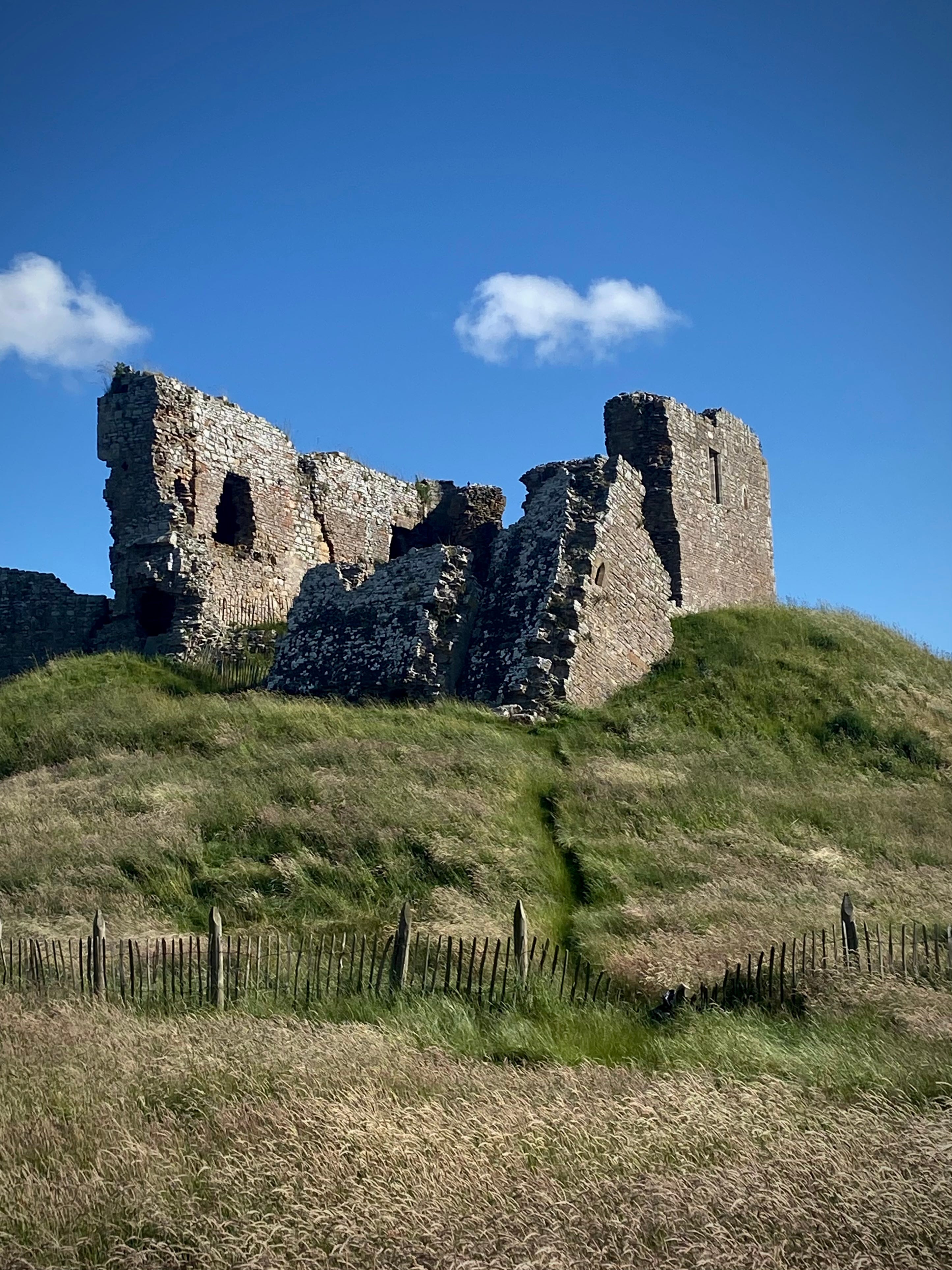
It is worth noting that, prior to this, in 1213, Andrew had been elected Bishop of Fortrose Cathedral at Ross, about 45 miles west of Elgin. However, for reasons unknown, he obtained the consent of Pope Innocent III to resign this position. I mentioned that my brother jokingly called him “Crazy Uncle Andy,” and this inexplicable development might offer a glimmer into his crazy heart. Why would he have passed over the opportunity to serve in the esteemed and coveted diocese of Ross at Fortrose Cathedral? Who knows? We do know that in 1222, Andrew happily accepted election as the Bishop of Moray after the death of Bricius the same year. Having been the “parson of Duffus,” Andrew may have declined the position at Ross simply wanting to be closer to home; in the 13th century, Ross would have been more than a full day’s journey to Duffus traveling by horse, by boat across the firth, and by longer coastal paths. When the opportunity arose to assume the bishopric of his home turf of Moray, he gladly accepted, especially since he had already been serving as rector of St Peter’s Church at Duffus. He went to Rome in early 1224, where he was confirmed and consecrated, and thus he formally ascended to the seat of the Bishop of Moray.
Shortly thereafter, on 10 April 1224, Honorius III granted Bishop Uncle Andy the needed permission to build a new cathedral at Elgin and the foundation stone of the new Holy Trinity church ( Elgin Cathedral) was laid the following July 1224. The bishops retained their living space at Spynie as their primary residence, so the See of Moray thus embodied both the majesty of its new cathedral and the familiar dwellings at Spynie, both of which served the local parish.
Andrew then undertook what would become his great legacy: erecting the great Elgin Cathedral, which came to be known as the “Lantern of the North” and which became one of medieval Scotland’s most important religious and cultural centers. The medieval Bishops of Moray maintained their seat there until the demise of the bishopric altogether, more than 300 years later, during the 16th-century Scottish Reformation. The building would be completed in 1242, the same year as Andrew Murray’s death.
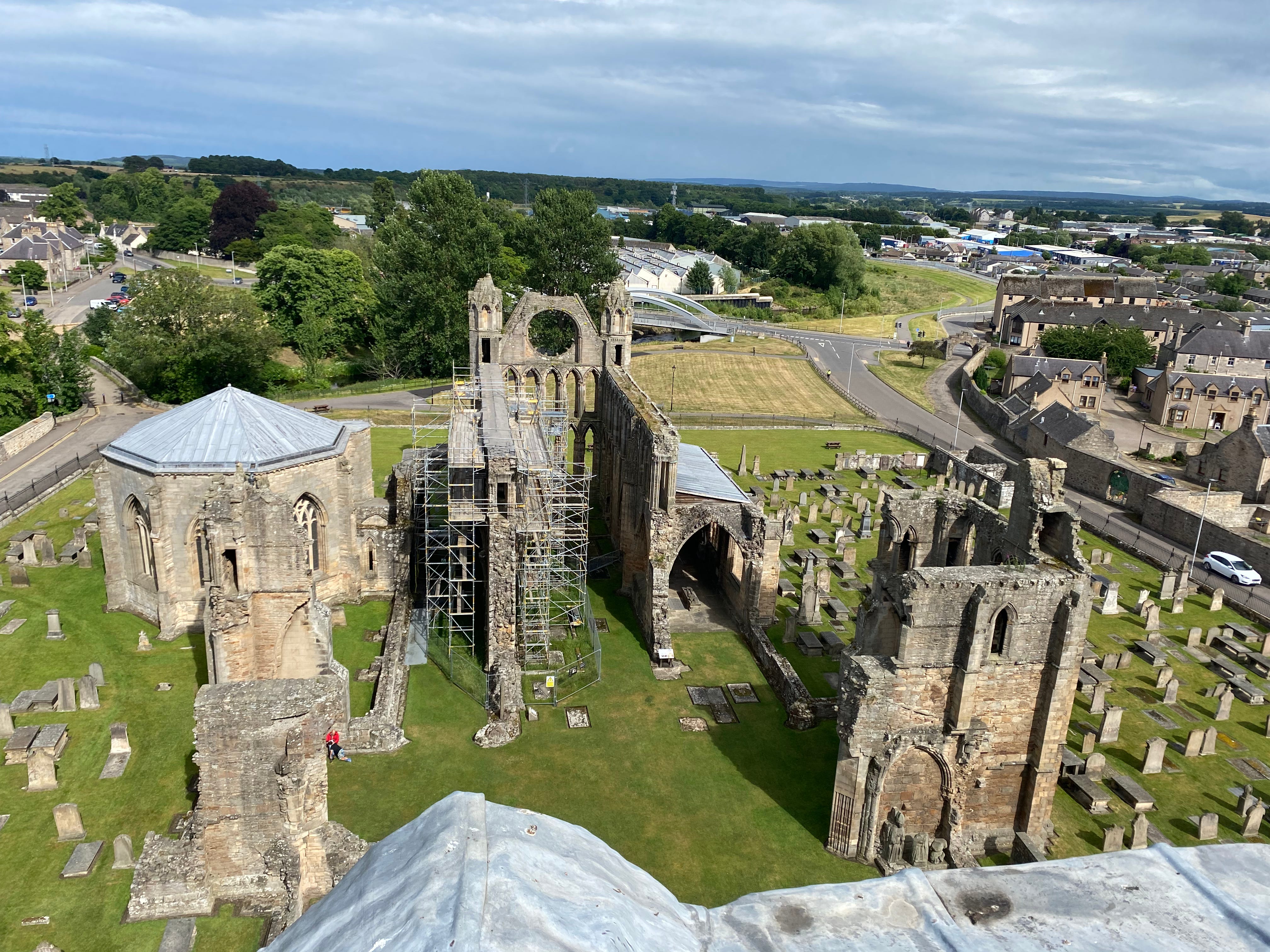
Under Bishop Andrew Murray, the chapter expanded from eight canons to 18. (A “chapter” is comprised of a bishop’s local leadership team; the leadership team is comprised of “canons.”) By the time of Andrew’s death in 1242, the chapter had grown to the respectable size of 23 canons. The growing staff meant greater influence. Andrew Murray further rendered the bishop’s seat “in perpetuity at the Elgin Cathedral,” meaning the cathedral would hereafter be the permanent home for the Bishops of Moray; there would be no going back to Speynie or Kinneddar.
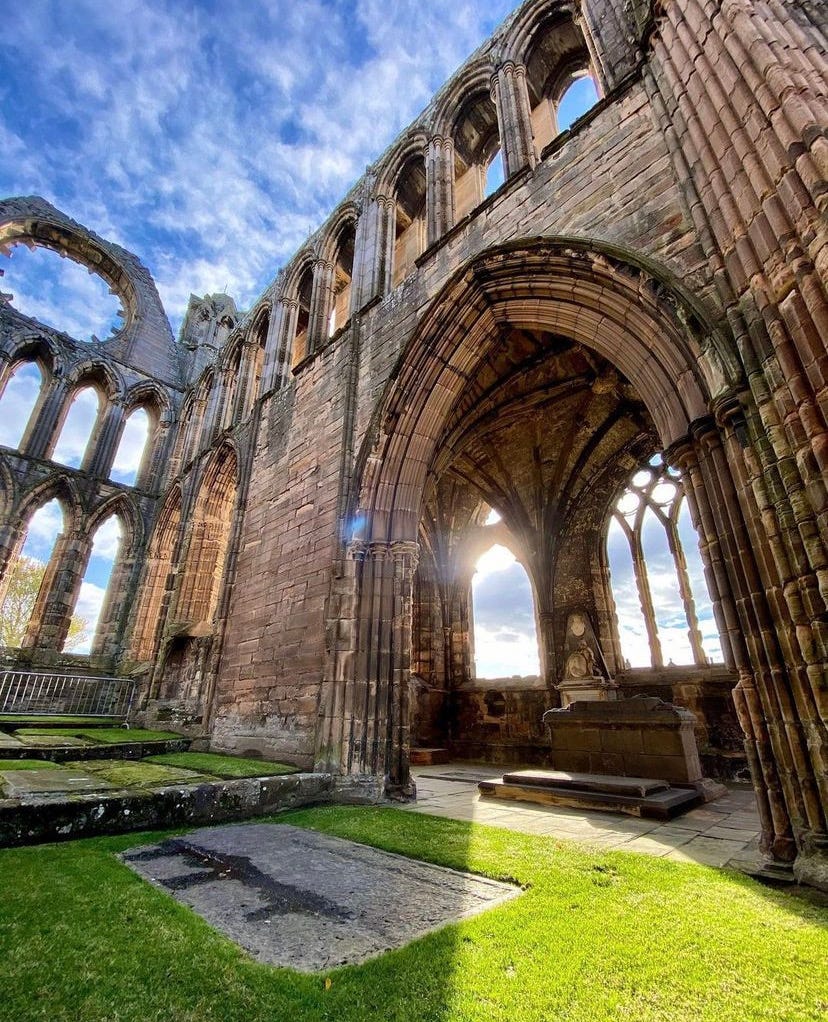
After Andrew died in 1242 (see his grave in the photo above), having secured the cathedral’s future and reinforced the spiritual heart of the region, Moray would continue to play a significant role in Scotland’s religious and political life. His own family and other key figures in Scotland’s story would emerge to benefit from the security and networking established by the bishops and their cathedrals. For the Murrays, this was particularly the case during the Wars of Scottish Independence.
So Crazy Uncle Andy rejected a gainful offer from Ross and patiently attended to a higher mission: he would serve and fortify the land where his great-grandfather fought and settled, and from which, it would turn out, other Murray heroes of the nascent nation of Scotland would arise. Crazy Uncle Andy laid the foundation for the spiritual and political consolidation that would inspire the battles waged and lost during medieval Scotland’s long struggle for freedom.